
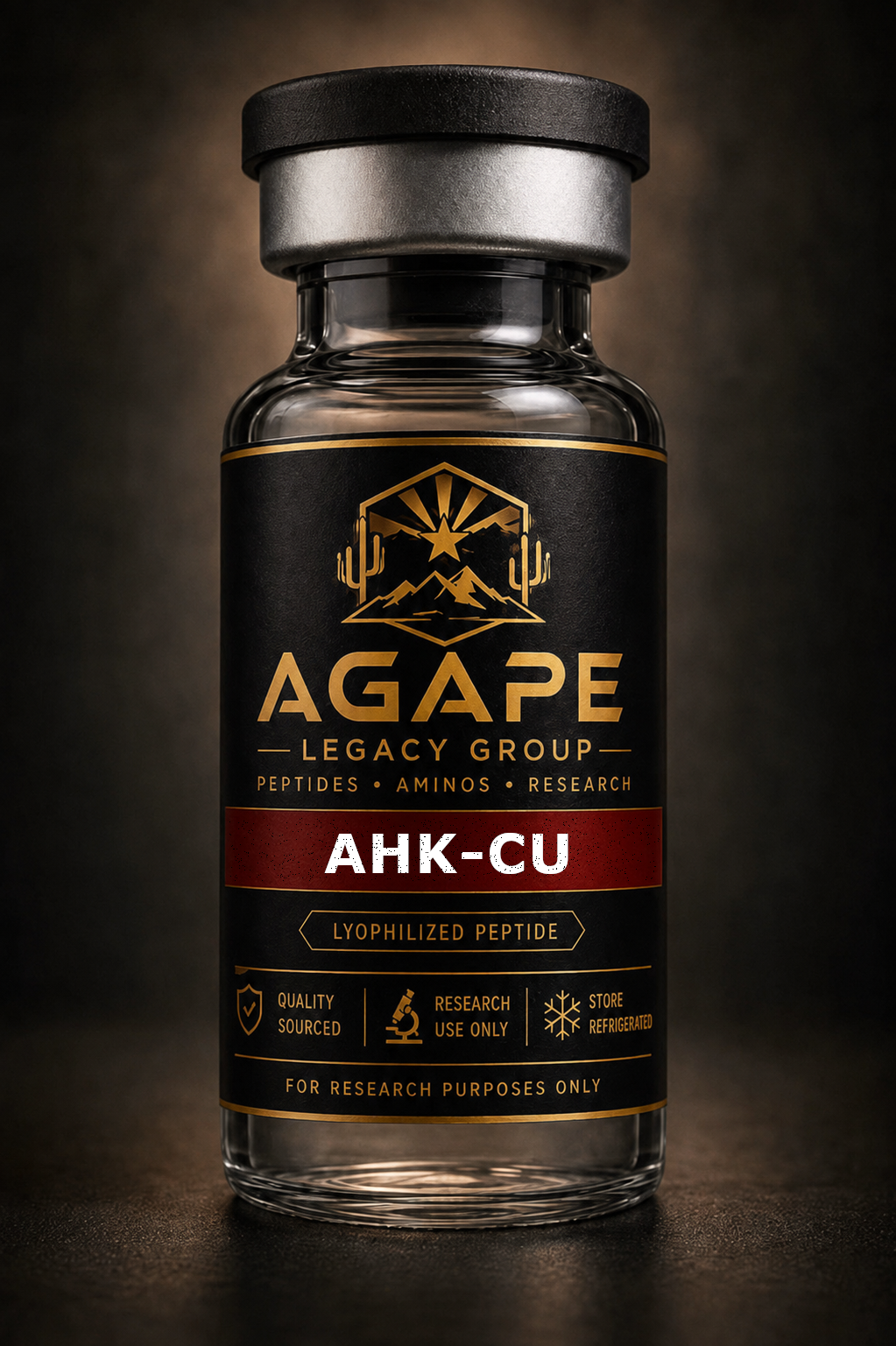
AHK-CU – 50 mg
$65.00
FOR RESEARCH USE ONLY NOT FOR HUMAN OR ANIMAL CONSUMPTION. This product is intended solely for laboratory research and analytical purposes and is not intended to diagnose, treat, cure, prevent, or mitigate any disease or condition.
AHK-Cu Research Peptide
The molecular composition of AHK-Cu peptide consists of three specific amino acids in a defined sequence, complexed with a divalent copper ion. This tripeptide contains alanine, histidine and lysine bound to Cu²⁺, creating a compact yet functionally significant molecule for research.
Amino Sequence: Alanine-Histidine-Lysine (AHK tripeptide) with copper(II)
Molecular Formula: C₁₅H₂₄CuN₆O₄ (copper complex)
Molecular Weight: Approximately 416 g/mol (complex); 354.41 g/mol (free peptide)
INCI Name: Copper Tripeptide-3
CAS Number: 682809-81-0 (monohydrochloride)
The compact nature of this three-amino-acid sequence makes it soluble and readily handled in experimental systems. Researchers studying peptide function may find that shorter sequences such as AHK offer advantages in research protocols, as they maintain specific coordination chemistry while remaining straightforward to synthesize and purify to high analytical purity.
The molecular structure also supports the peptide’s function as a research material. Its defining feature is copper coordination: the copper atom binds to three nitrogen atoms within the peptide structure, creating a stable complex. The histidine residue is central to this process, as its imidazole side chain serves as the primary copper-binding site and allows the sequence to chelate Cu²⁺ readily.
The lysine residue contributes a positive charge that may interact with cellular membranes, while alanine at the N-terminus distinguishes AHK from the closely related GHK sequence. Because glycine carries only a hydrogen side chain and alanine carries a methyl group, AHK is exactly one CH₂ unit heavier than GHK—a difference of approximately 14 g/mol. This single-residue substitution serves as a deliberate structural variable in comparative copper-peptide research.
AHK-Cu Peptide: Copper Coordination and Tissue-Remodeling Research
Proper storage protocols help researchers maintain the integrity and potency of AHK-Cu peptide throughout the experimental period. Store AHK-Cu in a cool, dry place, protected from light and with the safety seal intact, to reduce degradation and preserve the copper-peptide complex. Research facilities should implement appropriate temperature-controlled storage systems to help maintain the peptide’s molecular structure and copper coordination.
Researchers should establish their own experimental parameters based on individual study requirements. Relevant scientific literature should be reviewed, and suitable controls should be established when designing experimental protocols.
Copper-peptide complexes require appropriate handling conditions to maintain stability. Exposure to moisture, heat, direct sunlight, or repeated freeze-thaw cycles may compromise the complex and affect experimental reproducibility. Copper coordination is also pH-sensitive, so buffer selection should be considered when preparing research solutions.
A blue to blue-violet appearance may indicate copper binding. Any unexpected change in appearance should prompt verification against the relevant Certificate of Analysis before use. Research facilities should maintain detailed records of storage conditions, preparation dates, and expiration dates to support experimental consistency and data quality.
Laboratory personnel handling AHK-Cu peptide should follow standard safety procedures for research chemicals, including the use of appropriate personal protective equipment and proper disposal methods. Copper-containing compounds should be disposed of according to the facility’s procedures for metal-containing waste and should not be released into general drains.
Why Buy from Agape Peptides
Agape Peptides offers premium AHK-Cu peptide capsules in bottles containing 30 capsules, with 50 mg per capsule for consistent experimental protocols. Each serving contains the copper(II)-complexed AHK tripeptide, verified for intact copper coordination. Our commitment to quality control and standardization supports researchers who require reliable and reproducible materials.
The time-released vegetable-capsule technology provides controlled peptide-release profiles for consistent experimental outcomes. This delivery system can support more predictable results across applicable studies. The non-GMO capsule formulation may also assist researchers working within specific experimental or ethical requirements.
Researchers receive product specifications with every order to support consistency across multiple studies or research phases. These specifications include molecular-composition data, purity documentation, and handling information. This documentation enables research teams to maintain detailed experimental records and support protocol reproducibility.
Each capsule contains a precisely measured amount of AHK-Cu, together with excipients such as microcrystalline cellulose and silicon dioxide for stability and consistent delivery. This attention to formulation detail supports reliable experimental work.
Agape Peptides’ quality-assurance process includes molecular-identity verification, confirmation of copper content, and screening for contaminants that may affect research outcomes. These quality standards support research applications where purity and consistency are important.
| Dimensions | 10 × 12 × 0.5 in |
|---|